The Annual Wellness Visit, finished in one visit and ready to bill.
Your patient answers on an iPad, in Spanish or English. Your staff enters vitals. Your NP reviews what matters and signs. Medalto hands you the note for your EHR, the plan for the patient and the codes for your biller.
Built for primary care practices with Medicare patients. Flat monthly price, never a percentage of your collections.
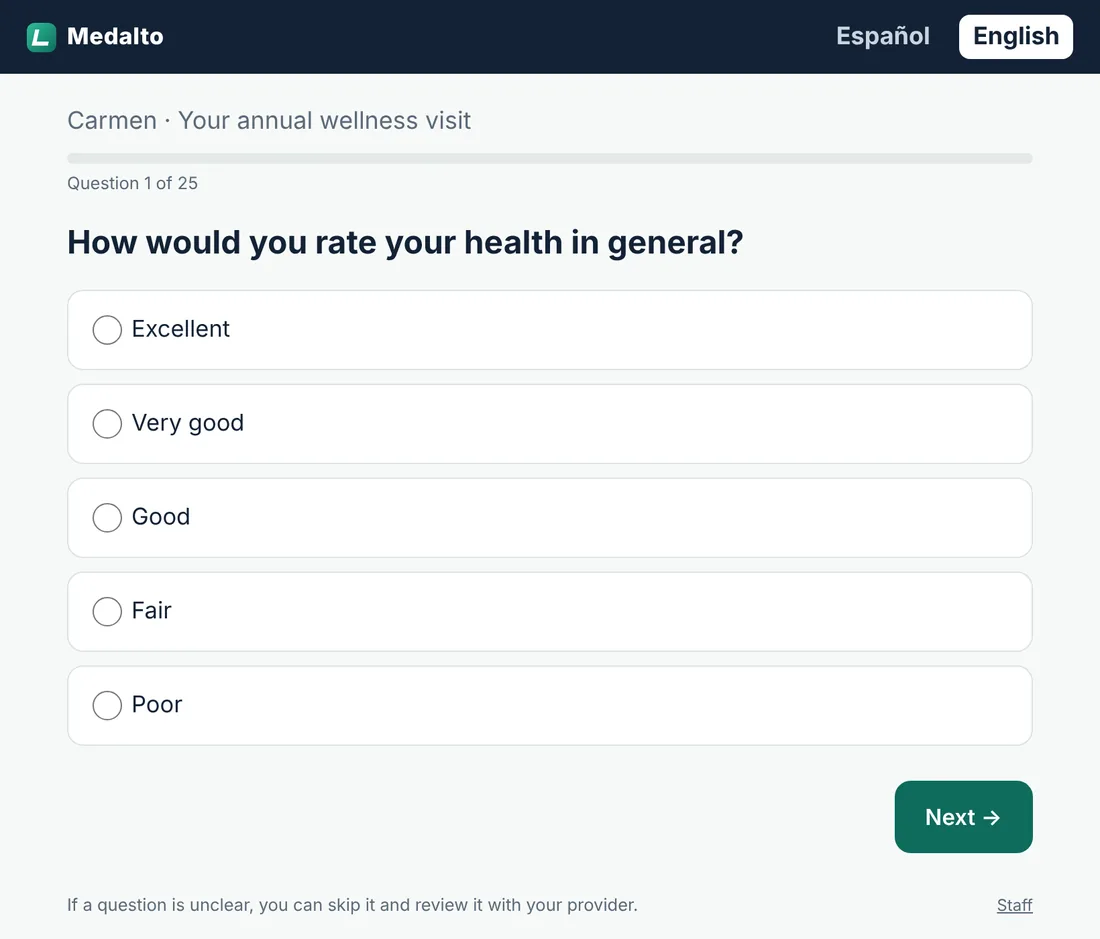
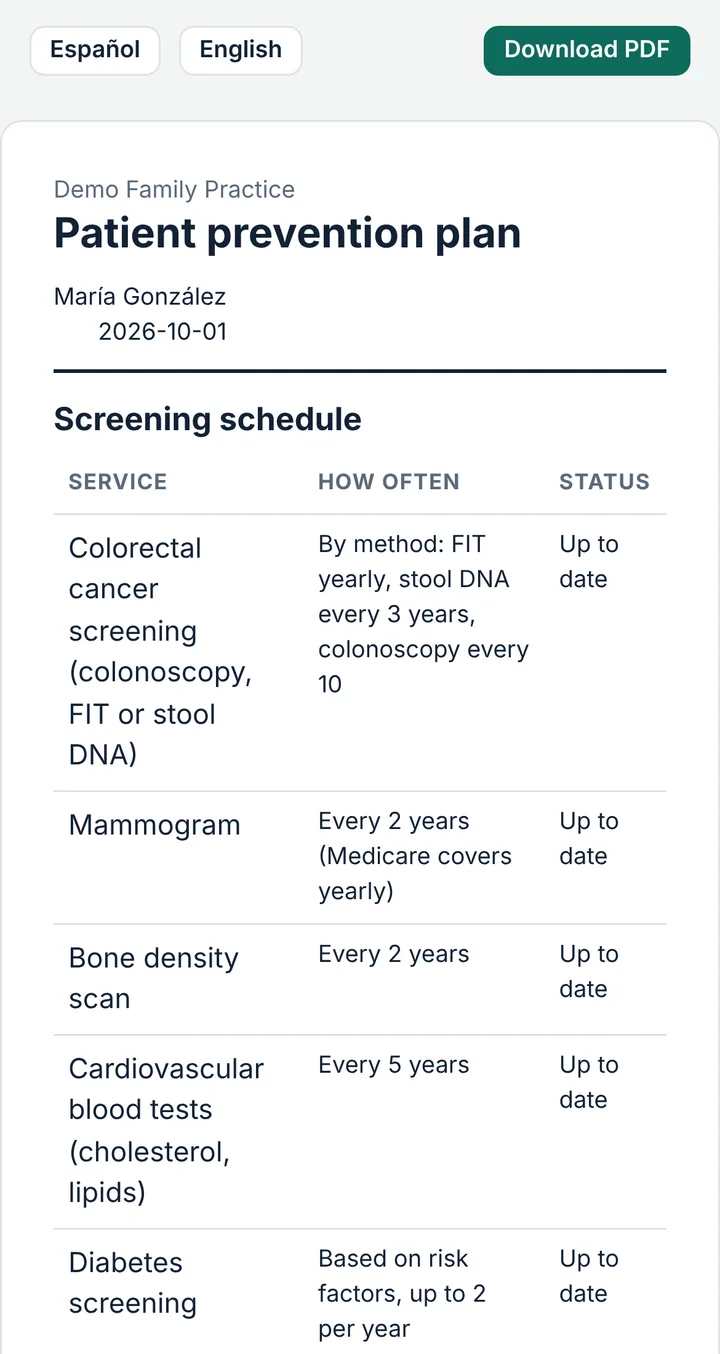
Most eligible patients don't get their wellness visit in a given year.
Medicare pays for an Annual Wellness Visit every year, and the patient pays nothing when you accept assignment. Yet when researchers looked at Medicare data for 2015 and 2016, only about one in four or five eligible patients got it1,2,3. In 2015, just over half of the practices with eligible Medicare patients did not bill a single AWV1.
It isn't that clinics don't want to. The visit is a long checklist: health risk questions, depression and alcohol screens, falls, functional status, cognition, opioid review, a screening schedule, advance care planning, and the exact timing rules that decide whether Medicare pays. On paper it eats the NP's afternoon. Medalto does the paperwork part.
The superbill you are not sending
Enter your numbers. We multiply by the 2026 national Medicare rates for the codes Medalto documents.
 Superbill
| Code | Service | Visits/yr | Rate | Per year |
|---|---|---|---|---|
| G0438 | Initial AWV | 0 | $174.35 | $0 |
| G0439 | Subsequent AWV | 0 | $137.61 | $0 |
| G0444 | Depression screening | 0 | $18.70 | $0 |
| 99497-33 | Advance care planning, first 30 min (modifier 33) | 0 | $86.84 | $0 |
Estimate only. National 2026 Medicare fee schedule amounts before locality adjustment and before the 2% sequestration reduction4,5; your Medicare Administrative Contractor's rates will differ. Medicare Advantage plans cover the AWV too, but pay what your contract says. Medalto does not guarantee any reimbursement.
How a visit runs
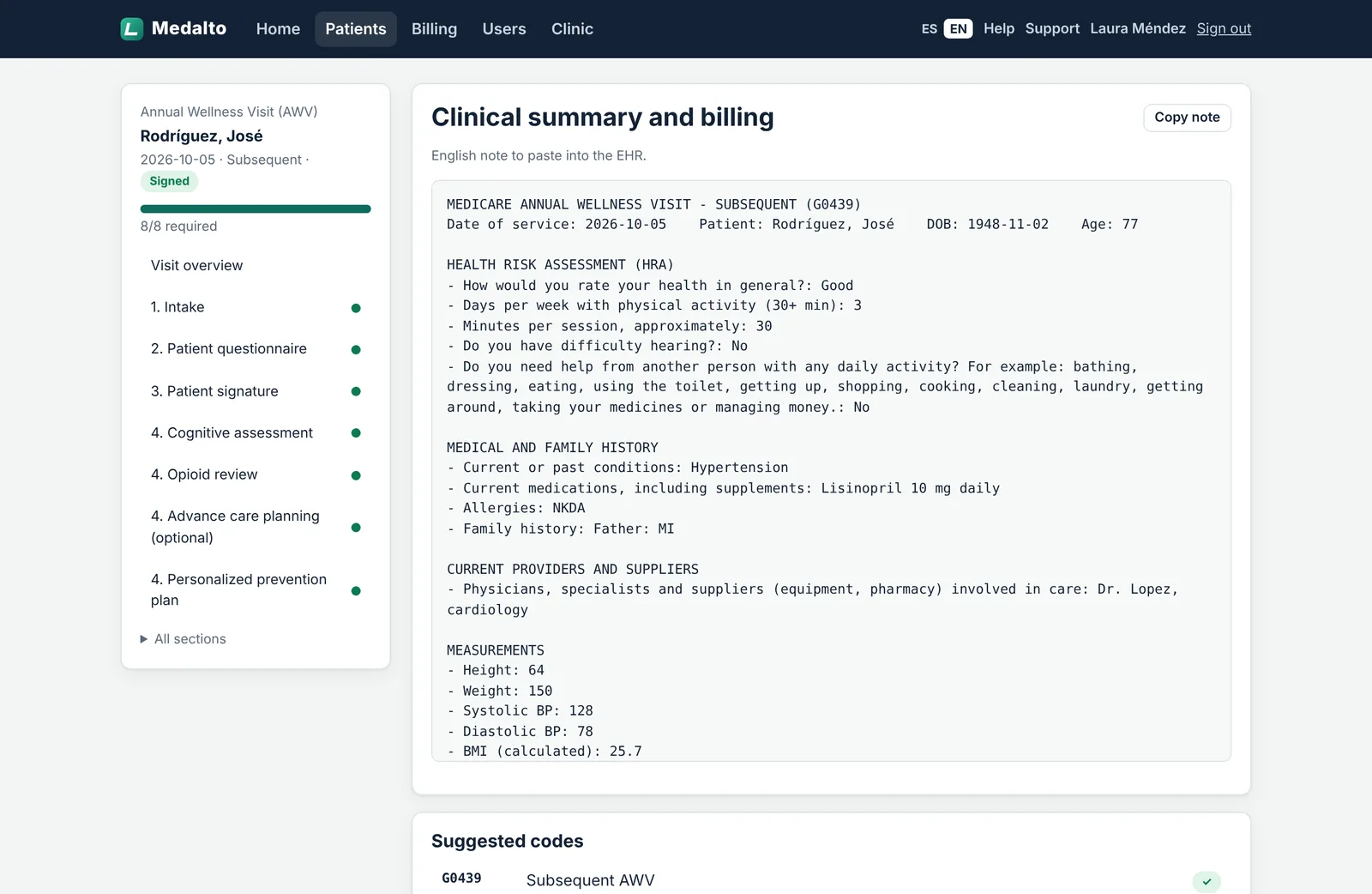
Four stages, each marked green when it's complete. On the iPad, answers save as the patient goes; staff screens save at each step.
Intake, before the patient walks in
Your medical assistant enters vitals, medications, history and providers. Next year, history, medications and providers come pre-filled from the last visit: review them and check confirmed.
The patient answers on their own
Scan a QR code with the clinic iPad and hand it over. One question per screen, in their language, and only the questions that apply: a patient with no issues answers about 33. No iPad? Lock the same computer in patient mode, or let the NP ask the questions.
The patient signs
With a finger on the iPad or with the mouse. The signature is stored with the visit.
Your clinician reviews and signs
Scores are calculated (PHQ-2, PHQ-9 only when needed, AUDIT-C, STEADI, BMI) and the answers worth a second look are flagged. Cognition, opioid review and the prevention plan, then one signature. Signed visits are locked.
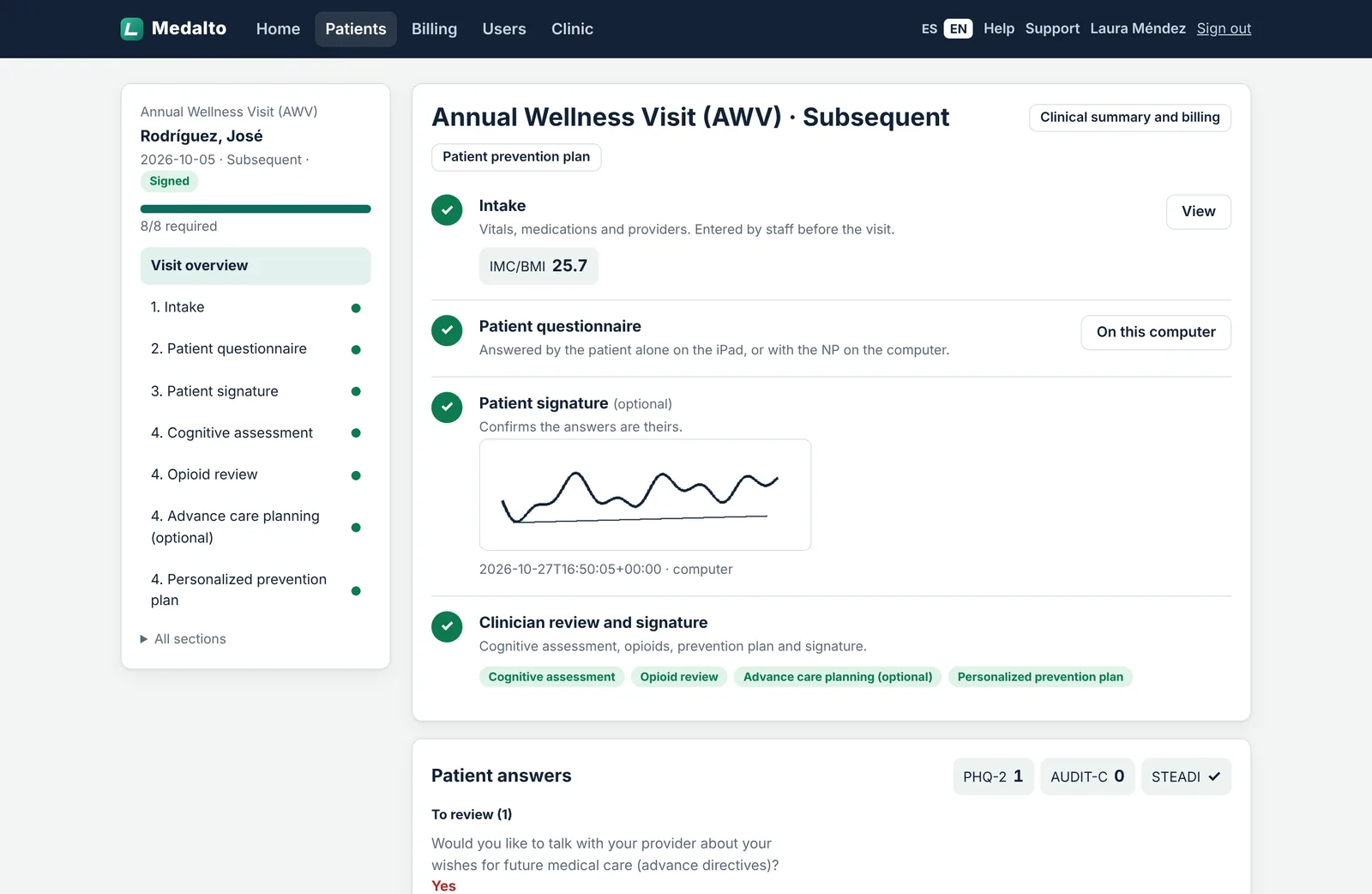
What you get when the visit is signed
A note for your EHR
The full clinical summary in English, with the suggested codes and modifiers, ready to paste into your record.
A plan the patient can open on their phone
Their screening schedule and advice, in their language. Send them a secure link by text, WhatsApp or email: they confirm their date of birth to open it and can download a PDF. You see when they opened it.
A billing control for every code
Each signed visit lands in a list by date, clinician and coverage: not billed, billed, paid or denied. Export to Excel for your billing company, or print the superbill.
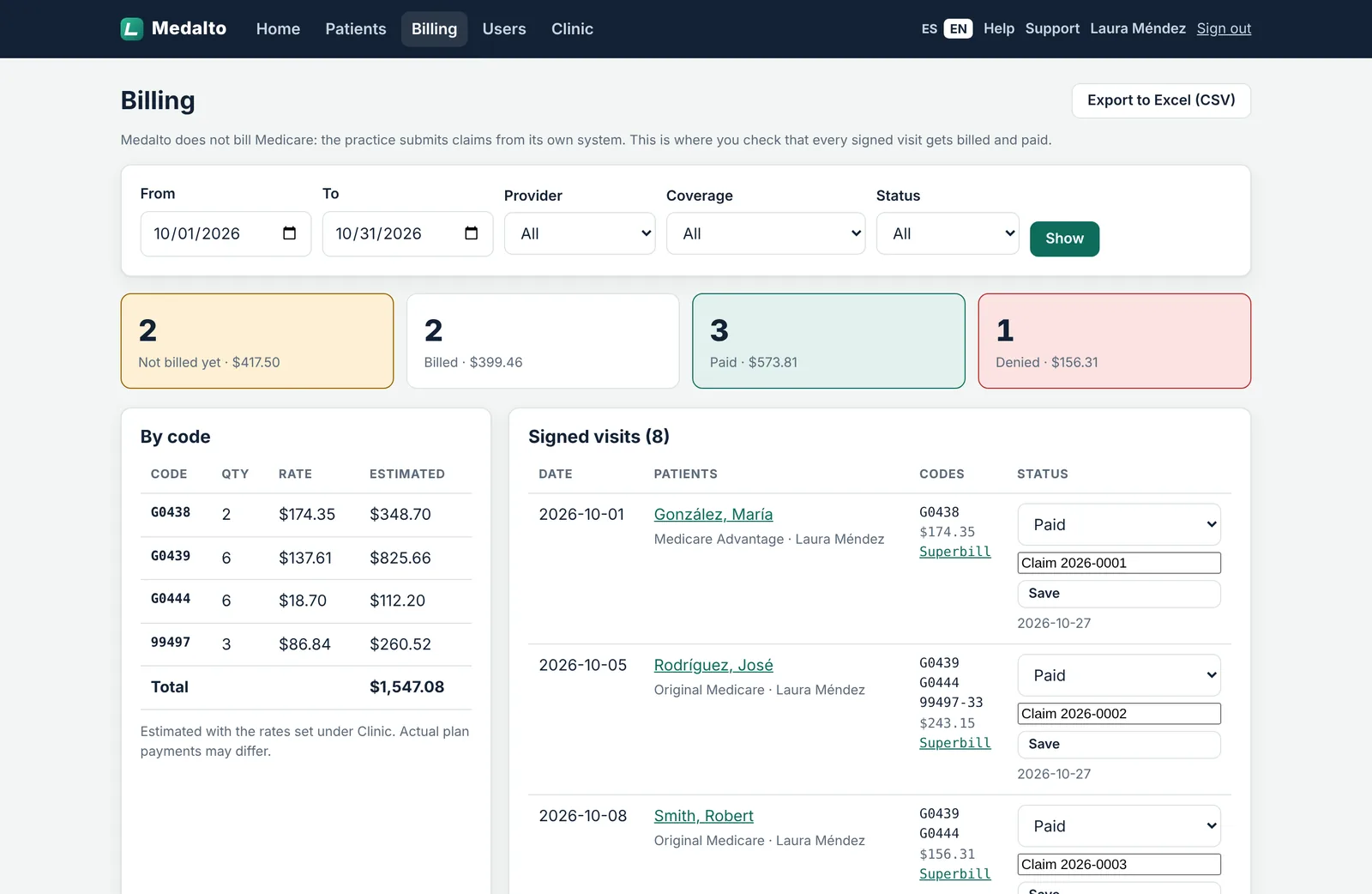
The codes Medalto documents
Medalto suggests the codes the documentation supports. Your clinician decides what to bill.
| HCPCS / CPT | Service | When | 2026 national rate5 |
|---|---|---|---|
| G0438 | Initial Annual Wellness Visit | Once per lifetime, after the patient's first 12 months of Part B, and after 11 full months have passed following the month of a Welcome to Medicare visit (IPPE), if they had one. | $174.35 |
| G0439 | Subsequent Annual Wellness Visit | Every year after the first AWV, after 11 full months have passed following the month of the previous AWV. | $137.61 |
| G0444 | Annual depression screening | With the subsequent AWV, not the initial one, once every 12 months. Requires staff-assisted depression care supports in your practice. Medalto runs the PHQ-2 and moves to the PHQ-9 only when it's positive. | $18.70 |
| 99497-33 | Advance care planning, first 30 minutes | At least 16 minutes, face to face and voluntary. Billed with modifier 33 on the same claim and day, by the same provider as the AWV, the patient owes nothing. Medalto records the time, consent and who took part. | $86.84 |
| 99498-33 | Advance care planning, each additional 30 minutes | From 46 documented minutes. | $78.16 |
Medalto tracks eligibility for every patient with the dates entered in Medalto: it lists who is due today and warns before you start a visit that falls outside Medicare's timing rules. It can't see visits billed by other practices, so confirm eligibility in your Medicare contractor's portal.
Medalto doesn't bill Medicare for you.
You keep billing the way you do today, from your own system or through your billing company. Medalto documents the visit, gives you the note and the codes, and keeps track of which visits were billed and paid, so none is left behind.
Medicare's requirements, point by point
What 42 CFR 410.15 requires in an Annual Wellness Visit, and where Medalto documents each item. Your clinician is still responsible for what is documented in every visit.6
Elements of the visit
| Required by Medicare | Where it is documented in Medalto |
|---|---|
| Health risk assessment, reviewed (and administered if needed) | Patient questionnaire: the patient answers alone on an iPad or with staff on a computer. The minimum content is listed below. |
| Medical and family history | Intake: conditions, medications and supplements, allergies, surgeries and hospitalizations, family history. Pre-filled from the last AWV and confirmed by staff. |
| List of current providers and suppliers | Intake: physicians, specialists and suppliers involved in the patient's care. |
| Height, weight, BMI (or waist circumference), blood pressure | Intake: measurements; BMI is calculated. |
| Detection of any cognitive impairment | Clinician review: method used (direct observation, patient or family report, brief structured tool) and result. |
| Review of risk factors for depression, with a standardized screening tool (initial AWV) | PHQ-2 for every patient, and the full PHQ-9 when the PHQ-2 is positive. |
| Functional ability and level of safety: hearing, activities of daily living, fall risk, home safety (initial AWV) | Hearing question, activities of daily living, CDC STEADI key fall questions and home hazards. |
| Written screening schedule for the next 5 to 10 years | Prevention plan: screening and vaccine schedule with status, given to the patient in their language (printed, PDF or secure link). |
| List of risk factors and conditions with interventions recommended or underway | Prevention plan: Medalto suggests risk factors from the answers and measurements; the clinician confirms them. |
| Personalized health advice and referrals | Prevention plan: counseling topics, personalized recommendations and referrals. |
| Advance care planning, at the patient's discretion | Optional section with time spent, which supports 99497/99498 with modifier 33. |
| Review of current opioid prescriptions | Clinician review: prescriptions, pain, non-opioid options, opioid use disorder risk and Florida PDMP (E-FORCSE) check. |
| Screening for potential substance use disorders | AUDIT-C for alcohol and a single-question drug screen. |
| Physical activity and nutrition risk assessment (optional) | The questionnaire includes basic physical activity and diet questions for the health risk assessment. Medalto does not administer a standardized physical activity and nutrition tool and does not suggest G0136. |
In subsequent AWVs the health risk assessment, history, providers, measurements, cognition, screening schedule, risk factors, advice, opioid review and substance use screening are updated; Medalto pre-fills what doesn't change.
Minimum content of the health risk assessment
| Required by Medicare | Where it is documented in Medalto |
|---|---|
| Demographics: age, gender, race and ethnicity | Age and sex from the patient record; race and ethnicity reported by the patient, with the minimum categories of the 2024 federal (OMB) standard. |
| Self-assessed health status, frailty and physical functioning | Self-rated health, unintentional weight loss, difficulty walking a block or climbing stairs, fatigue, activities of daily living. |
| Psychosocial risks: depression and life satisfaction, stress, anger, loneliness or social isolation, pain, fatigue | PHQ-2, stress, anger or irritability, loneliness, pain from 0 to 10, fatigue. |
| Behavioral risks: tobacco, physical activity, nutrition and oral health, alcohol, sexual health, motor vehicle safety (seat belt), home safety | Tobacco and pack-years, days and minutes of activity, fruits and vegetables, last dental visit and dental problems, AUDIT-C, sexual health concerns, seat belt use, home hazards. |
| Activities of daily living: dressing, feeding, toileting, grooming, walking (including balance and fall risk), bathing | One screening question; if the patient needs help, each activity is asked one by one. Fall risk with the STEADI key questions. |
| Instrumental activities of daily living: shopping, food preparation, telephone, housekeeping, laundry, transportation, medications, finances | Asked one by one when the patient reports needing help. |
The regulation also requires that the assessment can be completed by the patient alone or with a health professional, that it takes no more than 20 minutes, and that it fits the communication needs of patients with limited English or health literacy: Medalto offers Spanish and English, one question per screen, and only asks the follow-up questions that apply.
Source: 42 CFR 410.15, Annual wellness visits providing Personalized Prevention Plan Services.
HIPAA, in plain terms
There is no official HIPAA certification, so here is exactly what we do.
What we sign
- A Business Associate Agreement (BAA) with every clinic, before any patient data goes in.
- Servers are in the United States.
- Welcome emails and system alerts don't include patient data, and support requests ask users not to include it.
What the software enforces
- Two-factor sign-in for every clinic user.
- Automatic sign-out after 15 minutes idle (45 in patient mode), and a 15-minute lockout after 5 failed sign-in attempts.
- Every access to patients and visits, and every saved change, is logged with the user (or the patient link) and the time.
- Roles: staff enter data, clinicians sign, only people you choose see billing.
- Each clinic's data is separated from every other clinic's.
- Encrypted connections (HTTPS) everywhere.
- Patient links expire on their own: the iPad link in 2 hours, the plan link in 30 days and only after the date of birth matches.
- Daily database backups.
Pricing
A flat price per clinic based on how many active Medicare patients you have. No setup fee and never a percentage of what you bill.
Essential
$299/month
Up to 500 active Medicare patients
or $2,990 a year: 2 months free
Start a 30-day free trialPractice
$499/month
Up to 1,500 active Medicare patients
or $4,990 a year: 2 months free
Start a 30-day free trialClinic
$799/month
Up to 3,000 active Medicare patients
or $7,990 a year: 2 months free
Start a 30-day free trialEvery plan includes
- Every module feature: questionnaire on iPad or computer, signatures, notes, patient plans, billing control
- Spanish and English for patients and staff
- Unlimited visits, users and clinicians
- Onboarding for your team and support from inside the app
- Business Associate Agreement included
If your practice grows past its plan, nothing stops working: we move you to the next plan.
- 30 days free
- Use it with real visits before you pay anything.
- Month to month
- After the trial, no contract. Cancel whenever you want.
- Pay 10 months, get 12
- Choose the annual plan and two months are on us.
Questions clinics ask
Do we need new hardware?
No. Any computer with a browser works. An iPad or tablet helps the patient answer on their own, but it's optional: you can lock the same computer in patient mode, or the NP can enter the answers.
Does it replace our EHR?
No. Medalto handles the wellness visit and gives you the note to paste into your EHR. Your EHR stays your record.
Does Medalto send claims to Medicare?
No. You bill from your own system or your billing company, as you do now. Medalto tells you which codes the visit supports and tracks what was billed and paid.
What about Medicare Advantage patients?
The visit is the same. Medicare Advantage plans cover the AWV, and payment follows your contract with each plan. You can replace the national rates with your own, so the billing report reflects your fee schedule.
How long does a visit take?
The patient questionnaire adapts to their answers, so a patient with no issues answers about 33 questions on their own, before or while they wait. The clinician reviews the flagged answers instead of reading a whole form.
What if a patient doesn't read well or doesn't use technology?
Staff or the NP can go through the questions with them on the computer. Large text, one question per screen, Spanish or English.
How do we start?
Book a demo. We create your clinic, your team receives an email to activate their accounts with a link to the user guide, and you're running visits the same week.
See it with your own workflow
Thirty minutes on a video call. We run a full visit on the iPad and answer your billing questions.